LinkedIn Boosts Developer Output 20% Using Anthropic's MCP
LinkedIn has built an organizational context layer for AI coding agents using Anthropic's Model Context Protocol, achieving a 20 percent productivity boost with zero loss in reliability.
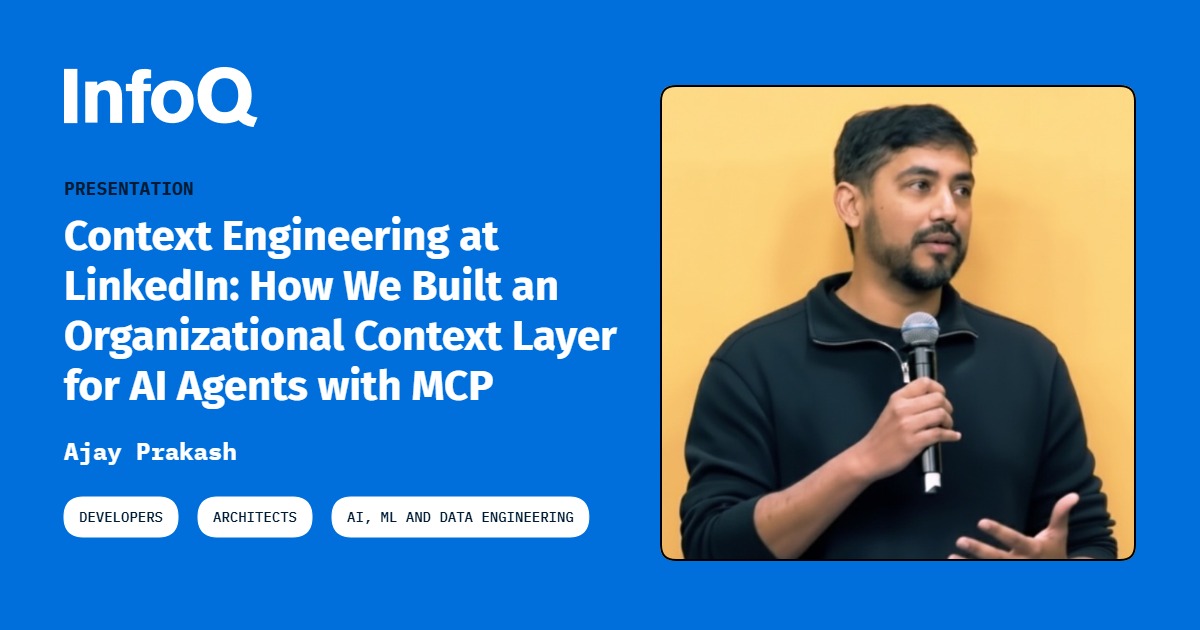
LinkedIn software engineer Ajay Prakash recently revealed how the company overcame the limitations of AI coding assistants within its massive codebase. While tools like GitHub Copilot are highly capable, they initially struggled with LinkedIn's custom infrastructure, which spans thousands of microservices and over 1,000 repositories. To bridge this gap, LinkedIn built a system called Contextual Agent Playbooks and Tools. This organizational context layer leverages Anthropic's open-source Model Context Protocol (MCP) to supply AI agents with procedural memory, code search, and runbooks. The implementation has delivered a 20 percent productivity boost for developers with zero loss in system reliability.
The initiative was prompted by the failure of "vibe coding"—a term coined by Andrej Karpathy in early 2025 to describe prompting agents to write and test code without manual intervention. Because LinkedIn's mature stack requires new human engineers to undergo a rigorous week-long bootcamp, AI agents without internal context frequently hallucinated or produced subpar code. By integrating MCP, LinkedIn connected these agents to internal tools, allowing them to search codebases, read wikis, and check feature flags.
To prevent context overload and solve the lack of durable long-term memory, LinkedIn introduced "playbooks" to serve as procedural memory. These playbooks contain specific instructions for tasks like setting up an Airflow pipeline. They are designed around the philosophies of self-containment and composability, allowing agents to progressively disclose context rather than overwhelming their context windows. If an agent encounters outdated instructions, it can improvise using other tools and automatically update the playbook, creating a continuous learning loop.
Architecturally, LinkedIn deploys a local MCP server to all employee laptops, which auto-updates every hour. To scale past the typical limit of 30 tools—beyond which agent performance degrades—LinkedIn replaced direct tool exposure with a search-based meta-tool system. Today, the system supports over 600 workflows and thousands of tools, secured by a seamless OAuth authentication layer and rigorous security audits.
This is our own summary of reporting by InfoQ AI